Home Blog Page 18

Helping Children Appreciate Diversity

In their first three years, children develop their abilities to think and speak, learn and reason, and lay the foundation for their values and social behaviour as adults. Preschool children are naturally curious about the world, and they have questions about specific things that they notice. Questions about physical, gender, ethnic, or racial differences may be difficult for some adults to answer. But the way we answer will influence the child who is concluding that something is “wrong” with a person who is different. Elizabeth Cary, author of Talking About Differences Children Notice, gives some guidelines for responding to awkward questions. Children are more comfortable with differences when they understand why people are different.

Respond Promptly

If possible, answer questions as soon as children ask them. If you ignore questions, children may decide that there is something wrong about the question or the person the question concerns. Children learn not to ask questions that make people uncomfortable. The last thing we want to do is to teach children not to ask questions. Prejudice often begins when children develop misconceptions based on their limited experiences.

Give Simple Answers

Answers should be simple and relate to a child’s experience and level of development. If a child asks, “Why is that man so dark?,” you can say simply, “He is dark because his mother and/or father is dark. You have blond hair just like your mother.”

Model Respectful Behaviour Verbally and Non-Verbally
Many people were taught as children not to stare. They were taught so well that they avoid looking at all who dress differently or who have disabilities. Toddlers are sensitive to the feelings of the adults around them, and they begin to mimic adult behavior.

Acknowledge Children’s Fears

Some children are afraid of the unknown. They may have wrong ideas about people who are different. They may be suspicious of unusual people and resist the new and different. Fears should be accepted, and children should be offered help to deal with their fears. Helpful responses acknowledge the child’s feelings. When discussing diversity, we can stress human similarities first, then help children appreciate people’s differences. You might say, “You’re scared of the woman in the long clothing.” Then give the child the tools and experiences to help her deal with her fear.

Introduce Differences Through Books and Other Props
It can be less threatening for some children to meet people who are different first in a book. Issues surrounding differences can be discussed in terms of the characters in the book. Then you can broaden the discussion to include children in the group or people in the community. Select pictures, toys and games showing people of different races, all ages, both genders and differing abilities as capable and involved in all types of activities.

Remember, though, that actions speak louder than words. Model, through your words and deeds, interest in a variety of people and differing beliefs, behaviours and customs. We must be especially careful about how our actions shape the values that children learn as they encounter the people in their world. If we don’t act, they will learn by default the messages that are all too prevalent in the world. And we’ll find ourselves perpetuating ideas that we really do not want to pass on to our children.

Adults can help children make choices and act in ways that reject bias by instilling in them that
“If someone calls you a name that hurts your feelings, you can tell them they’re wrong and they shouldn’t do that. You can ask the teacher for her help if anyone does that to you, or if you see someone doing that to somebody else.”

These example suggest ways to support anti-bias learning in young children. As with all other learning, repetition is important. Children will need many opportunities, over and over again, to explore similarities and differences, to try out new experiences from different traditions, to meet and get to know people from different backgrounds, and to ask questions — even embarrassing ones that we might not have easy answers for!

Source: Reprinted with permission from the National Network for Child Care – NNCC. Brink, M. (1994). Helping children deal with differences. In Todd, C.M. (Ed.), *Child care center connections*, 4(3), pp. 1-3. Urbana-Champaign, IL: University of Illinois Cooperative Extension Service.
Source: Canadian Child Care Federation Resource Sheet #35, Helping Children Respect and Appreciate Diversity. Reference: Derman-Sparks, Louise et al (1989). Anti©Bias Curriculum Goals. Washington, D.C.: NAEYC. Available from Louise Derman-Sparks, Pacific Oaks College, Pasadena, California.)

Teaching Environment

Begin by acquiring as much knowledge as possible about different cultures, ethnic groups and lifestyles. The children’s families are wonderful resources for this kind of information. Provide children with access to a wide array of multicultural materials on a regular basis. Your teaching environment should include:
Paints and crayons in a range of skin tones
Books that show diverse cultures and counteract gender stereotypes
Photographs of people from various ethnic groups
Positive images and opportunities for positive contacts with people with disabilities
Toys such as dolls of varying colours, sizes, gender, even those with disabilities, and dress up clothes for all genders and costumes from various cultures if accessible.

Look over your environment and materials with a “multicultural eye,” remembering that the primary purpose is to generate positive feelings. Although inclusion of materials and activities is important, what really matters is the respect that teachers model when dealing with other adults and children.
After all, children learn by our example, and if we show understanding, appreciation, respect and acceptance for different cultures and life experiences, the children in our care will, too.

Scheduled Activities

Scheduled activities will help in your quest to teach children respect for others. The challenge is to teach children that:
Everyone has the unique gift of individuality to share with others
No matter how unique or different a person is, we each share basic human needs
Being different, whether in sex, race, culture or abilities, does not mean inferior
Every individual is a part of a cultural group with uniqueness and gifts to share with others.
Toilet Training Young

PHILADELPHIA, PRNewswire via COMTEX/ — Researchers at The Children’s Hospital of Philadelphia report few benefits to starting toilet training in children younger than 27 months of age. Below that age, children took much longer to become toilet trained, and were not more likely to complete training earlier, than children who started training at a later age. Above that age, starting toilet training earlier led to early completion, but even then earlier training was likely to take longer. Earlier initiation of intensive toilet training was not associated with more toilet training problems such as constipation or stool withholding.

Research

Children’s Hospital researchers collected data from 378 families, most of them white, middle-class and from suburban Philadelphia. They particularly focused on intensive toilet training, defined as asking the child to use the toilet more than three times per day. The research is reported in the April issue of Pediatrics.

“Though we did not find more toilet training problems in the younger children, we found no clear benefit to beginning training earlier than 27 months,” says Nathan Blum, M.D., a developmental pediatrician at The Children’s Hospital of Philadelphia and lead author on the study. “In fact, earlier training is likely to take longer, which can be frustrating for both parent and child.”

To document toilet training progress and completion, researchers conducted phone interviews with families every two to three months. In each follow-up interview, information was collected including how often parents asked or reminded the child to use the potty, the presence and frequency of constipation or painful defecation and information on toilet training behaviors.

Parents

Parents in the study reported beginning intensive toilet training at a mean of 28.7 months and completed training at a mean of 36.8 months. Children who began intensive training at less than 27 months took between 10 to 14.5 months to train, while those who began training at 27 months or later took between 5 and 9.5 months. Consistent with existing data, the boys in the sample completed training later than the girls, at a mean of 38 months and 35.8 months respectively.

“Our study does not suggest that 27 months is a clear milestone for every child,” states Bruce Taubman, M.D., study co-author and physician in the division of Gastroenterology and Nutrition at The Children’s Hospital of Philadelphia. “Parents should consider their child’s individual readiness, family situation and cultural beliefs when making the decision to initiate training.”

In the field of child development, there is a lack of clear data on which developmental skills should be used to judge toilet training readiness, adds Dr. Blum. “We are hopeful that this study is useful in helping parents think about what age might be most appropriate and effective for their child.”

In addition to Drs. Blum and Taubman, Nicole Nemeth, M.D., a third-year resident at The Children’s Hospital of Philadelphia was also a co-author on the study.

Founded in 1855 as the nation’s first pediatric hospital, The Children’s Hospital of Philadelphia is ranked today as the best pediatric hospital in the nation by a comprehensive Child magazine survey.

Teaching Kids About Cash

Between the ages of 2 and 4, children learn to count, and by age 4 they know that in order to get what they want in a store, they have to pay for it. By age 5 or 6 they can distinguish between pennies, nickels, dimes and quarters, and many kids are already making small purchases on their own.

The earlier children get used to handling money and dealing with change, the better. It gives them “money confidence”. What follows are some great learning opportunities parents and child care providers can use to teach preschoolers about money.

What Children Learn From Money

Money teaches children counting, shapes and sizes, sharing, identifying things, decision making skills, budgeting, the value of work and responsibility.

Social Skills

There are many opportunities to teach children about money while at the same time enhancing their social skills. In your dramatic play area you could set up a restaurant, grocery store, flea market, etc., complete with menus, plastic food, and play money. They can pretend to be waiters and waitresses, cashiers and shoppers.

You might also let your children play store with a little bit of real money. Give them plastic change purses to carry some pennies, nickels and dimes in. (See the Art and Craft section below to make change purses.) Encourage the children to count their money before they go out shopping so they can get an understanding of how much money they have and what they might be able to buy with that money. This is also a great time to talk about saving when the children see they don’t have enough money for a higher ticket item.

While playing storekeeper, waiter, etc., you can talk to the children about how these people earn their money. This will open up a discussion about allowance, saving money, banking, budgeting, etc. Teach children that family members work to pay for food and clothes. Let the child visit different workplaces like the grocery store, the fire hall, even the public library.

A visit to the bank would also enhance their learning experience with money. It provides an opportunity to talk about ATM machines and that their parents can’t get money out of the bank or machine unless they put some money in, and so on.

Language Skills

Read stories about money matters and responsibility. Your librarian will be happy to help you pick out simple easy-learning books on money, like, Pigs Will Be Pigs : Fun With Math and Money by Amy Axelrod, The Go-Around Dollar by Barbara Johnston Adams, 40 Ways to Teach a Child Values by Paul Lewis, or Pick Up Your Socks…and Other Skills Growing Children Need! by Elizabeth Crary. Don’t forget to check out our list of Web sites below that can help you teach children about money in a fun and interactive way.

Here’s a great little song and coin recognition exercise the kids will enjoy. Write the following song (sung to the Farmer in the Dell) on a white board or large piece of paper and tape the corresponding coin at the end of each line. :
Cents
A penny is worth 1
A nickel is worth 5
A dime is worth 10
And a quarters worth 25

Arts & Crafts

Change Purse
Cut an rectangle out of heavy construction paper. Fold the paper two thirds of the way to make the change section of the purse and leave enough room for the flap. Glue the sides together. Cut a circle or square of Velcro and glue to the inside of the flap and close to the top of the inside portion of he change purse. Let the children decorate their purse with beads, glitter, or just with markers or crayons. Put each child’s name on his her purse. You could also make the purse out of plastic, punching holes along the side and having the children string the purse together. A snap could hold the purse closed.

Money Jars
Have the children decorate three jars or cans, then label them Spend, Save and Share and put their names on the jars. The children can put a portion of their allowance into each jar so they can see what they can spend now, how fast their money is growing, and how they can share their money with the less fortunate, or to help a worthy cause.

Science/Cooking/Math

Cooking:
Help the children make some simple baked goods such as muffins or cookies to host a bake sale. Have them make notices about the bake sale to post at the facility and to send home with the parents. At the end of the day the children can set up the goodies for the parents and themselves to purchase. This helps the children learn the value of their money, to give change to the parents, and how working (i.e. being a baker), helps them earn money.

You could also bake cupcakes and set up different stations around the room where the children can pay a penny for each decoration they want on their cupcake, like sprinkles, a cherry, etc. The money raised from the sale can be divided equally amongst the children and placed into their three jars made during crafts.

Science:
Children learn by what they see and do. Using coins, ask the children what they can see? Feel? Do? Talk about the different properties of coins. Paper money too. Talk about how money is made at the mint. Gather books from the library on the properties of copper, nickel, silver, etc.

Help the children start a coin collecting. Take some time going over the different dates on the coins, the different faces of the coins. Show the children some old coins if you can. Perhaps some parents can help you here. This is a great way to explain the history of money.

Math:
Using money is a great way to help youngsters learn to count. Take some time with the children
to really look at each coin and read the words on it. Ask them to look at the nickel and tell how the nickel is different from the penny in size, color, and value. Make a chart showing how many pennies there are there in a nickel, a dime, and a quarter. Or have each child draw a circle on a piece of paper and write a number on it from one to ten. The children can then take their pennies and place the right amount under each circle. You can do the same for a dime or a quarter, using nickels. Talk about the different combinations of coins for values more than five cents, such as five nickels make a quarter, two nickels make a dime, etc.

Save, wrap, count coins and take them to the bank.

Using Heroes To Teach Values

This month’s theme focuses on helping children develop a sense of what is noble and good and worth striving for in life. By using heroes to teach values, parents, caregivers and teachers are feeding young minds with examples of goals that are worth pursuing, qualities in human beings that are admirable and worth emulating, and that heroes are just people, like you and I, who are helping other people and making a difference in the world.

When teaching about values and heroism, it is important to selected heroes from various cultures in different parts of the world. This will help the children to realize that heroes are in every culture and that race has no bearing on heroic acts and the values they reflect.

Using heroes to teach values allows teachers, through real life examples or through fiction, to exemplify virtues such as honesty, civility, courage, perseverance, loyalty, self-restraint, compassion, tolerance, fairness, respect for individuals, responsibility, and so on.

It also provides opportunities to point out that human kindness is important in our daily lives, as are respect for our parents, family, and everyone in our community, honesty and trust in all our relationships, helping those less fortunate than ourselves, and being generous which ultimately brings us such happiness.

Foundation for a Better Life

child care online recommends caregivers and parents visit the Foundation for a Better Life Web site for theme ideas, stories, and to help set the tone for their program.

“The Foundation for a Better Life creates public service campaigns to communicate the values that make a difference in our communities, values such as honesty, caring, optimism, hard work, and helping others. These messages, communicated utilizing television, theatres, billboards, radio, internet, etc., model the benefits of a life lived by positive values. The Foundation encourages others to step up to a higher level and then to pass on those positive values they have learned. These seemingly small examples of individuals living values-based lives may not change the world, but collectively they will make a difference. And in the process help make the world a better place for everyone. After all, developing values and then passing them on to others is The Foundation for a Better Life.”

Social Skills

There are many ways you can teach children the value of heroism right in your own community. You could:
Arrange for the children to spend some time in the community providing support for older generations by paying visits to senior’s centres, nursing homes, community centres, etc.
Invite local heroes to come and talk to the children. Through this you could also teach language skills by write a letter inviting the local hero to pay them a visit, and follow up with a thank you letter.
Have the children participate in community events like cleaning up local parks or planting trees.
Visit the local fire hall or police station. Bring them cookies or hero ribbons or badges of courage made by the children in appreciation for their bravery each and every day.
Talk to children about ways they can be a hero as a group. Perhaps they could assist a needy family at Thanksgiving or Christmas, take up a can good or penny drive to present to a local charitable organization, recycle products to save the earth, raking leaves for seniors, and so on.

Language Skills

Stories about female and male heroes in history and in fiction will grab the children’s attention and give caregivers an opportunity to lead a discussion about values. Teachers can ask questions about what type of hero the person was, what they did that made them such a hero, and what the children could do today to be like the hero. Such stories about heroes provide examples of values that students can recognize and follow.

Other language enhancing projects might include helping the children to write letters to the New York Fire Department or their own local fire department. Herein lies an opportunity to discuss with the children the important work done by Fire Fighters. You could also talk about other community helpers and their roles. Talk about how they protect and keep us safe. Use the brainstorming session to write out words such as – appreciate, safe, community, courageous, brave, strong, determined, etc..

Talk to the children about the different characteristics of a hero including:
Personal sacrifices
Outwitting formidable foes
Acts of bravery (get pictures or real-life samples of badges given to citizens for acts of valour, etc.)
Overcoming racism or discrimination
Unlikely heroes like children, animals, persons with disabilities
Determination and courage
Historical heroes like Martin Luther King, War heroes, Native heroes, etc.

You could help the children draw a picture and write a simple sentence like: “If I were a hero, I would…” You could give examples such as, care about their friends, help their parents, be kind to people, say hello to neighbors. Or, you could pick a theme as presented on The Foundation for a Better Life to demonstrate the different values the children can possess that make a hero. This exercise encourages children to think of themselves as heroes and feel good about it.

And don’t forget to make a trip to your local library. Your librarian can assist you with your Hero theme offering great books to read, ideas for language skills, crafts and cooking, etc.

Arts & Crafts

I am a Hero Bookmarks
Take strips of heavier construction paper and have the children make I Am a Hero Bookmarks. When they are done, punch holes in the top of the strip and tie on a simple tassel. The children can be any type of hero they choose. Examples of bookmarks can be found and ordered through
http://www.imahero.com/teacherspage/bookmarks.htm

Heroes Hall of Fame (or Bulletin Board)

Create a display in your entrance hallway or on a bulletin board displaying pictures, simple articles, and the words you talked about during your reading times of heroes. The children can draw their heroes, cut out pictures of police and firefighters from magazines or newspapers, or bring in pictures of their parents, grandparents or other family members they are proud of and look up to. Be sure to include stories and pictures (you can also print out stories off the Internet, of children who are heroes). This gives encouragement to the children….if these other children can do great things…so can they.

Ribbons and Medals

Have the children decide which heroes they would like to honour. This could actually turn into a monthly project, for example, this month we’ll honour our war Veterans. Make honourary ribbons of honour or hero medals out of ribbon and paper. Help the children decorate the ribbons with a special phrase or simple notation of what the ribbon is for. With the children, write a letter to the Veterans society and invite a number of local Vets to visit the children. When they are done telling the children about their gift to their country, their bravery and courage, have the children recognize their sacrifices and courage by bestowing them with the ribbons of honour. A refreshment party could proceed this event.

Science/Cooking

Cooking: Children enjoy cooking at the best of times. But when they know they are cooking a special treat for a hero, their efforts takes on a whole new sense of pride and appreciation. During the hero theme the children can bake cookies, make muffins or other treats to give to the guest they’ve invited to visit them, or to the seniors they visit, or just as a thank you gift for the Firefighters. Cooking time also provides another opportunity to discuss the values of a hero, or to have the children tell their own stories of heroes in their lives.

Science: Depending on what hero you chose to learn about, there may be an opportunity to learn about science. Take a story of Benjamin Franklin for example. Your local librarian can help you with book on simple science activities for the children related to his contribution to mankind. And there is certainly something to be learned from the story of Florence Nightingale or Amelia Earhart.

Integration – The Best Of Both Worlds

Janet Rosenthal gladly recounts the story about Maria Jackson, a beautiful, witty little girl who suffers from multiple sclerosis. “She’d arrive at school about the same time my kids did, only she’d come by way of the handicapped bus. It used to fascinate my kids,” she says with a smile.

“Sometimes my children would feel sorry for Maria, which was okay,” Janet notes, ” I wanted them to learn to appreciate the difficulties other people experience. But it also gave me an opportunity to talk with them about how Maria was just the same as they were, how she liked to wheel around the school yard in her wheel chair just like they liked to run, or how she’d always be telling jokes, just like them. It also gave us a chance to talk about what neat things Maria got to do that they didn’t, like ride on the bus everyday, instead of walking. They came to love and appreciate Maria for who she was, not for what made her different.”

Integrating Children With Special Needs

Janet was discussing the positive impact integrating children with special needs at had on her children. And she is not alone. Mainstreaming challenged children into regular child care settings, be it family daycare or centre-based care, is paying off in huge dividends. Non-challenged children are learning to appreciate and respect their challenged peers, and in many cases, gaining skills, like sign language, that allows them to communicate better with challenged friends.

Their challenged friends gain self-confidence. By interacting with their peers, they learn to explore their limits, to accomplish tasks that may not have been afforded them in a specialized care. Through important social interaction and the availability of the same resources afforded non-challenged children, challenged children are able to develop to their fullest potential.

Still, there are parents and caregivers who are uncomfortable with the whole idea of mainstreaming. “The integration of handicapped children into “regular” programs in education has been subject to many misconceptions,” writes the National Institute on Mental Retardation, Children With Special Needs In Daycare, A Guide To Integration, 1990.

“The general concept of integration includes a range of situations from instances where there is only physical proximity between groups of handicapped and non-handicapped children, to instances where there is close interaction between handicapped and non-handicapped individuals.”

The guide reports that legitimate concerns arise about the amount of care given the handicapped child over that of the non-handicapped child, the expense and changes involved in alternations to the program, environment and personnel to accommodate the special needs of the handicapped. “If integration is to work, … careful decisions must be made concerning such factors as staffing requirements and alterations to the environment. The adjustment of all the children to the situation must be carefully guarded.” the guide says.

Parent Involvement

Parent involvement, both with the parents of the challenged child and the parents of the non-challenged child is paramount to the success to any integration program. Sharing information about the child and his/her needs encourages questions and dispels many of the misconceptions parents of non-challenged children may have.

Fortunately, there are many wonderful agencies, like SpeciaLink in Sydney, Nova Scotia, who can assist those looking to find a placement for their special needs child, those who have questions about mainstreaming, and those caregivers and centres who are interested in opening their doors to challenged children. After all when it comes to integration, everyone – parents, children, and staff benefit.

For more information on integration, contact SpeciaLink at (902)562-1662, of you local Social Services office.

Good Behavior Is Learned Behaviour

It has been said that ‘what we wish to appear in children, we must put into our schools. Setting up a character development theme is more than a one day, one week, or one month event. To be beneficial, it’s best to focus on one character trait at a time. Themes can be based on the “Six Pillars of Character”: trustworthiness, respect, responsibility, fairness, caring and citizenship. With each theme, explain the trait to the children as it relates to their their realm of experiences. You might begin each day talking to the children about a real event in the world in which the trait was displayed.

As an example, you could ask: What does it mean to be respectful? How do we show respect? Listening to the teacher or to your parents, saying “please” and “thank you”, might be some of the areas you’d want to focus on. Mention that if we expect the other children to respect us, we have to respect them. Even very young children can give you their ideas on how they can show respect in the daycare.

Telling children what a character trait is, however, only provides half the learning process. You have to show them the behavior, let them see you practice it. Give the children opportunities to role play the trait with each other. It’s a simple way to show them exactly what the trait looks and sounds like.

You might consider setting up a “Catching Kids Being Good” program. Try to catch the children doing the trait right. Praise them for it. Let the other children know what you saw Katie doing for Michael. When you reinforce good character, children are more likely to repeat the behavior. Set up rewards like”happy face” stickers or for obeying the rules and be consistent with consequences for disobeying them.

Before beginning your character development program, you might want to host a parent/teacher meeting to discuss the “Six Pillars of Character” and what is being done in the daycare to teach these values. Encourage parents to reinforce these lessons and to discuss their importance at home. Hand out information for them to read, and give them a list of resources such as the ones listed below, the books included in our Book Review section, and the Web sites listed in our Web Stuff section. A great printable poster of the characters is available from the CharacterCounts.org Web site.

Social Skills

During the toddler and preschool years, parents and caregivers spend a lot of time talking about not hitting, grabbing, kicking, or pushing. Because youngsters do not have the language skills necessary to solve their problems, they quite often resolve issues by hurting others. Such instances provide teachable moments to let the children know what behavior you’d like to see instead of the hitting and pushing. Give them alternatives such as a gentle touch on the arm to get another child’s attention is better than bites or hits.

Circle time provides the perfect opportunity for the children to do activities together that help build caring within the group and individual caring between students. Going around the circle and asking each child “How are you today?” emphasizes the fact that it is respectful to listen when someone talks. It also gives opportunities for bonding and empathic growth. In another circle time activity children can pay complements to one another, with the receiver being taught how to accept a compliment gracefully and to say thank you.

Introduce a “put-up”, “put-down” game to the children. On slips of paper write ways in which some of the ideas for children to encourage each other, called ‘put-ups’, such as “Tina, you made a nice drawing today!” Next, write out ways children talk badly to each other, or ‘put-downs’ such as “You’re stupid for building a sand castle.” On a daily basis, have the children taking turns drawing a “put down” and “put-up” from the sheets of paper. Talk about how the children would feel after reading each statement. Ask for their input on other ways they might use “put-ups” instead of “put-downs.”

Playground and recess activities provide plenty of opportunities for teaching kids not to shove each other, to wait their turn to ride on the tricycle, and how they should act to show more respect to each other and the caregiver.”

Language Skills

Feature short discussions of the trait word of the month. Talk to your local librarian about books that have activities to go with the trait theme. Notify parents of the theme for the month and ask them to spend time at home reinforcing the same. Perhaps you could suggest some bedtime stories that promote the month’s value.

Using a large flip chart or poster board, write out the “Trait of the Month”. With the children’ help, make up a few simple “Codes and Rules of Conduct” that should go along with the trait and that they should practice this month.

Using a large letter stencil, help the children trace and cut out each letter for the trait. They can then make a long banner clueing on the letters and then discussing other words that might go along with the trait word and writing these on the banner as well. Once the words on done, the children can draw in the rest of the banner.

Make up some ribbons with the phrase “I am a person of character because…”, and give one to each student to complete. This is also a great circle time activity as well allowing the children to share their character story with the rest of the children.

Arts & Crafts

Character Vision
Using 12-inch pipe cleaners (one for each child), 6-inch pipe cleaners (two for each child),
twist ends of 12-inch pipe cleaner together to form circle. Twist the circle to make a figure 8. Give the figure 8 an added twist to make the nose bridge. Attach two 6-inch pipe cleaners to each side. Have the children test them out by putting on their glasses and seeing how well they can spot respect, or whatever the theme trait is. 1

Create placemats with the trait of the month.

Have students build six “pillars” from corrugated cardboard or construction paper and colour them in. Write one of the six characters on each pillar. Place the pillars in a highly visible place in your facility and refer to them often.

Music

Using a guitar, talk to the children about how each string plays its part in making wonderful music. Explain how one string out of tune will ruin the sound, and that it’s the same when we don’t cooperate or meet our responsibility to be kind and considerate. The music isn’t so lovely as it could be.

Form a band with each child playing a different instrument. Talk about how each member of the band, like the Back Street Boys, has to get along with all the other members if they are going to be successful. Explain how the members of the band respect each other’s talents and how hard they work together to make just one song sound so good.

Science/Cooking

Cooking:
Have the children put together a fruit basket, gently placing the pieces of fruit inside the basket to demonstrate cooperation, caring, kindness, respect, etc., and how hurting a piece of fruit can bruise it, much like we bruise people when we say bad things to them or hit them. When the basket is done, the children can deliver it to a seniors home, the fire hall, or other place they can care about.

At the lunch or snack table, talk to the children about the food they are eating. Ask them, “what if” questions to demonstrate the importance of doing our part and working together. For instance, “What if the farmer didn’t grow the vegetables? What would we eat to get our vitamins?” Or, “What if the truck driver didn’t go to work because he wanted to go to the show instead? How would our food get to the grocery store?”

Lunch and snack times can be used to reinforce good table manners.

Science:

Cut out leaves from green construction paper or use real leaves the children have gathered on a walk or from the yard. Have them give each leaf a good character trait. On a large piece of Bristol board, help the children draw and colour in a tree trunk. The children can glue their good character leafs to make the tree nice and green. Talk about how all parts of the tree have to cooperate with each other in order for the tree to grow. The roots have to gather the water to feed the tree. The trunk has to transport the water to the branches, and the branches have to feed the leaves, etc.

Play a “What if” game with the children during science centre. For example, have them answer questions like, “What if the bees refused to leave the hive and buzz around the flowers?” Explain how the bees pollinate the flowers that grow the fruit and how they work together to make honey.

You can reinforce the respect trait by discussing respect for our environment, and reading books such as Johnny Appleseed.

Overcoming Shyness

In any group of children there are always some who find it hard to join in the fun. Here are some ways to help your child, or a child in your care, overcome their shyness.

* Work with your child to make a list of situations that make her feel shy. This could be anything from joining the group at circle time or sitting at the lunch table. Pick one situation to work on.

* Role play the situation with your child. For example, the children are playing a game in group. Your child wants to join in but is too shy. She doesn’t go and feels badly as she pouts and looks on at the group.

* Help your child think of ways to
deal with this situation. For example your child could join the group but not play the game until she feels ready. She can laugh as she watches the other children.

* If it comes to her turn in the game tell her to join in once. If she doesn’t like it she can pass on her next turn and just play along. Or she can pass completely and still play in the game.

* Make a list of things your child care do to overcome her shyness in care. For instance, she could find one special friend to hang out with. Or she could ask to stand by the teacher during group time if that will make her feel more comfortable. The teacher can praise her efforts and help her adjust to the group easier.

Helping your child take little steps to overcome her shyness will give her the confidence she needs to try again in different situations.

Resource:

MegaSkills by Dorothy Rich, Houghton Miffin

Creating A Learning Environment

Mention a learning environment for children and a room full of toys, books, puzzles, counting beads, and art supplies comes to mind. Rightly so, for these are, after all, a child’s intellectual and social ‘building blocks.’

What doesn’t come to mind, however, is that the first step to creating a learning environment is to ensure all children have adequate nutrition, health care and stimulation. Proper meal planning with regards to the federal food guide is essential. Parents should take the time to review a centre’s or home’s weekly menu, or talk to their provider about how well their child is eating.

Health care, of course, entails more than just regular visits to the pediatrician or health clinic, though these are paramount. It also includes a safe environment, for example, lead free paint on all surfaces, well-constructed toys and child care apparatus, as well as proper hygiene practices.

The amount of stimulation a child receives also plays a role in a learning environment. To little stimulation and the child learns nothing about him/herself or the world in which he/she lives. Over stimulation, an environment that is too busy and confusing, gives a child little chance to absorb anything.

Optimal Learning Environment

All that considered, what else makes for an optimal learning environment? Notes Deborah Lott Holmes, in her book, The Child, An Introduction To Developmental Psychology, “The optimal environment is one that is geared to the child. At each stage of development, the child should be exposed to tasks slightly beyond his or her abilities. If the tasks are too easy, the child will quickly loose interest in them. If they are too complex, the child will give up and turn to easier tasks.”

Some suggestions for infants? ‘Simple’ toys such as pacifiers, rattles and teething rings for sucking and grasping, and easy to look at objects like a rag doll with a pleasant face are best, as is a quiet environment.

From 8 – 12 months, balls, containers, small toys, musical instruments and simple picture books provide hours of entertainment. The age group also enjoys interactive games like ‘peek-a-boo.”

By 18 – 24 months, children need a variety of more complex manipulative toys like puzzles, dress-up clothes and so on, and more complex picture books to help them mental explore their world and work out solutions to everyday problems.

Preschool children benefit from ‘same and different’ games and books that demonstrate the idea that “one of these items does not belong to this group.” Too, this age learns volumes from playing in sand and water with measuring containers of various sizes.

“Children should be given ample opportunity and encouragement to explore their environment, use their imaginations, and talk about their discoveries and fantasies,” says Holmes. She suggests children be taught focal colours and learn the concepts of numbers better if they are taught by concrete example rather than by memorization. Counting beads and stacking toys are excellent for this age group.

Our Role

Parents and providers play a large role in the learning environment. Even with the best materials, children need guidance and adult interaction to broaden their learning experience. A seed planted as a suggestion works wonders. For example, while in the art centre, providers can ask the children to paint a picture of what ‘fairy land would look like if they lived there,’ or, in the reading centre, they could ask the children what they liked best about a certain book, how they felt about a character, if they ever have the same feelings the character has.

And, of course, children need free play, a time undisturbed by adult interaction, questions or pressures to complete a project in a short period of time. It is when a child is dreaming and creating that he or she is utilizing the learning environment to its fullest.

Character Building Through Caring Hearts

Anyone who works with children can tell you first hand there is a growing rise in disrespect for parents, teachers, and other authority figures. Young children are increasing becoming crueler with each other. Youth violence is on an upward swing and dishonesty, like lying, cheating, and stealing, is prevalent like never before.

Until recently, calls for school reform have focused on academic achievement. Educators, from preschool on up, now realize that along with the three Rs, children need courses in character development. Daycares, schools, parents and community, all have an important role to play in helping children develop good manners, moral and ethical behavior.

What is Character Education?

Dr. Thomas Lickona, Director of The Center for the Fourth and Fifth Rs, defines character education as “the deliberate effort to develop virtues that are good for the individual and good for society. The objective goodness of virtues” Lickona says, “is based on the fact that they:

* Affirm our human dignity
* Promote the well-being and happiness of the individual
* Serve the common good
* Define our rights and obligations
* Meet the classical ethical tests of reversibility (Would you want to be treated this way?) and universality (Would you want all persons to act this way in a similar situation?).”

Character education programs provide positive changes in children’s behavior, specifically in helping each other, being truthful, and not blaming others. And while no one thing is going to have much of an impact on a child’s character development, talking about virtues and vices as situations happen at home, at the daycare or at school, plus modeling virtuous behavior ourselves, can help to create a sense of a moral world for children.

More than that, it just makes sense to teach young people right from wrong. After all, isn’t child-rearing and teaching all about helping our children to become good people who can live healthy, happy lives of purpose?

“Six Pillars of Character”

Most of the character development programs available to parents and teachers center around the “Six Pillars of Character”:

* Trustworthiness
* Respect
* Responsibility
* Fairness
* Caring
* Citizenship

Who Developed the “Six Pillars of Character”?

The language itself came out of a summit conference on character education convened by the Josephson Institute in 1992 in Aspen, Colorado. The diverse group of educators, youth leaders and ethicists who gathered there to investigate ways of working together agreed unanimously that these six values are clearly central to ethical people’s lives, regardless of their differences. Whose values? Some 40 states and almost 1,000 cities, counties, school districts and chambers of commerce (plus the President, the U.S. Senate and House of Representatives) have endorsed CHARACTER COUNTS! and its “Six Pillars” approach to community-wide character education. 1

Teaching Children About the “Six Pillars of Character”

The most important thing that children should take away from character development training is that:

* Their character counts and their success and happiness will depend on who they are inside
* That people of character know the difference between right and wrong and that these people use the “”Six Pillars of Character”” as a guide to their thoughts and their actions.

The teacher’s role in character education is to introduce a lesson/topic of the “Six Pillars” one at a time. Dr. Borba, author of Character Builders, says there are five steps to building these character traits. The first is to target the desired behavior for 21 days. The second is to define the needs and values of the trait. The third step is to teach what the trait looks like and sounds like. The fourth is to provide structured practice for 21 days. The fifth is to reinforce the trait through immediate feedback and encourage uses for the trait in life.

Building character in children can also be reinforced through the use of visual and activity tools throughout the day. Posters, activity books and other small, creative and fun ideas can make this a project in which kids want to participate!

Once the process of character building has begun, the Josephson Institute, on their Web site Charactercounts.com, suggests teachers and parents:

* Be Consistent. The moral messages you send must be clear, consistent and repetitive. Thus, everything you say and do, and all that you allow to be said and done in your presence, either reinforces or undermines the credibility of your messages about the importance of good character. Be as firm and consistent as you can be about teaching, advocating, modeling and enforcing these “”Six Pillars of Character”.” The intention is to foster the virtues of good behaviour via constant “teachable moments”

* Be Concrete. Building character and teaching ethics is not an academic undertaking, it must be relevant to the lives and experiences of your children. Talk about character and choices in situations that your children have been in.

* Be Creative. Effective character development should be creative. It should be active and involve the child in real decision-making that has real consequences. Games and role-playing are also effective. Look for “teaching moments,” using good and bad examples from TV, books, movies, and the news.

We only need to look at programs such as “Kindness Is Contagious: Catch It,” which began in a single Kansas City, Mo., school and has since spread to more than 400 public schools in the area, to see the success creative character building programs can achieve. This particular program is sponsored by the Stop Violence Coalition.

Activities

Among the activities the program encourages is one in which children are asked to fill up two jars with beans. One jar contains a bean for every time a child receives a put-down, insult, or injury; another jar contains a bean for every time a child receives a “put-up” or an act of kindness. This activity provides children with a visual image of what they are doing to each other. The goal: to increase the put-ups and decrease the put-downs.

A second activity is called “Pass It On.” A teacher provides an overview of what kindness is (i.e. the 21 days of learning), and then when the teacher witnesses an act of kindness amongst her students, she or he gives the kind child an object such as a red apple, and tells the child that he or she is now a witness and must pass the apple on to whomever he or she sees is performing an act of kindness.

A copy of the guidebooks describing the program and its activities are available for $20, by writing to: Stop Violence Coalition, 301 East Armour, Suite 440, Kansas City, MO 64111.

Summing It Up

Dr. Kevin Ryan outlines the teaching of character development education best in his article, The Six E’s Of Character Education:

* Example. Example is probably the most obvious way to model character education. Another method for moral modeling is to teach the moral truths embedded in literature and history.

* Explanation. We need to practice moral education by means of explanation – not simply stuffing students’ heads with rules and regulations, but engaging them in great moral conversations about the human race.

* Exhortation. Used sparingly and with explanations, helps children and employees understand that a a good student or worker is someone who makes class contributions, does homework and assists other students.”

* Ethos. Providing an ethical environment – climate within a classroom promotes a steady and strong influence in the formation of character and the student’s sense of what’s right and wrong.

* Experience. Providing students both in-and out-of-school opportunities to serve.

* Expectation of Excellence. Excellence in school work and behavior will encourage students to develop qualities like perseverance and determination, and those virtues will affect every aspect of the children’s lives as they mature.

The end result of character development education: Children who, as adults, will contribute to the community, and whose moral leadership, values and citizenship will make the world a better place.

Resources:

“Six Pillars of Character”
Josephson Institute

The Center for the Fourth and Fifth Rs
Dr. Thomas Lickona, Director

Kindness Is Contagious
By Mark Moran , MPH

The Six E’s Of Character Education
By Dr. Kevin Ryan

Character Builders
By Dr. Borba – moralintelligence.com

Kindness Is Contagious: Catch It
Stop Violence Coalition

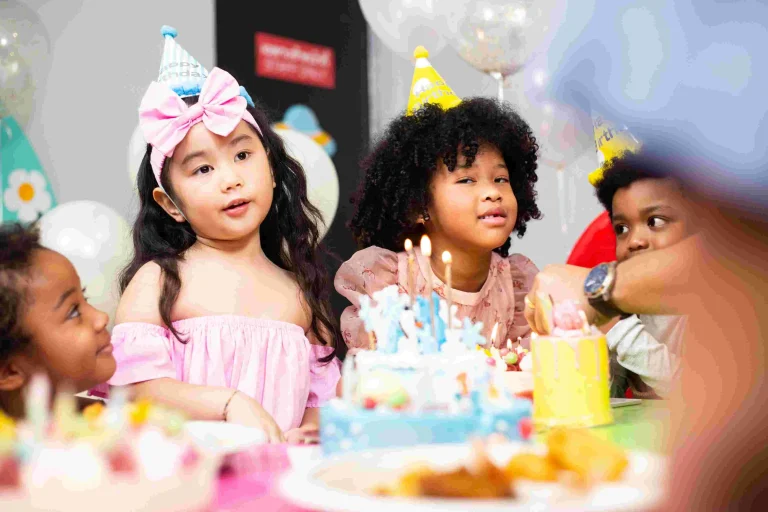
Daycare Birthday Celebrations

0

It Can’t Be That Hard …

What’s to having a party for the child at his daycare? It can’t be that hard, right?

Well, no, it isn’t that hard if you’re properly prepared and you know the rules in your child’s daycare. Assuming you can just go in there and have a party is probably a big mistake. However, by consulting with the daycare you can determine how to best celebrate your child’s big day. Many daycares like to include the parent(s) of the child having the birthday and might also include any siblings, aunties, cousins or special people who can make it.

Abide by the Rules, Please

Some daycares won’t let you bring store-bought items because the daycare is “nut-free” and “allergen-free”. You want to be sure that the foods are in line with policy. Generally speaking, pizza and homemade cupcakes with just a little icing along with some juice are about all you need in terms of food. Avoid cake. Little kids just like to stick their fingers in it and end up making a mess. Cupcakes, especially the mini-cupcakes are easy, clean, and just enough for a tiny tummy to handle. Little kids love pizza, especially three- and four-year-olds, but they’re not limited to it. Small sandwiches, bagels, veggies and dip and fruit on skewers are all options. Pick healthy foods and remember that sugar sends a lot of kids over the top. The daycare workers have to deal with the aftermath of the party and a room full of sugar-strung kids can be challenging.

Location, Location, Location

Ask the daycare if you can decorate. Choosing a theme like Dora, Handy Manny, Barney, or Mickey Mouse makes decorating really easy. Buy the little plates, hats, and balloons and pick a time that is convenient for the daycare and yourself to go in and decorate. They may do it for you if you ask. If the daycare has a backyard and the weather is good, an outdoor party is fun for little kids. You can pick a theme that fits with the outdoors, like a jungle theme, and plan a couple of games that allow for the kids to burn off some energy.

The attention span of young children is very short and, depending upon the daycare, they may only want to devote a couple of hours at most to the celebration – which is probably more than enough. On the other hand, there are daycares that are happy to dedicate an entire half day to making a party – playing games, painting, making special things to celebrate the birthday. Often the daycare will make a hat for your child or a sash and decorate a chair to make your child feel special.

Should You Have Presents?

Although children usually associate their birthday with presents (depending upon the age of the child), daycare probably isn’t the place for that. Instead, you might want to let your child pick out a book for the daycare and have it dedicated in honor of your child’s birthday. The kids in the daycare will love it and your child will feel very special.

Goodies for Everyone

Party bags are another item to consider. These should be handed out at the end of the day by the daycare to the children as they leave. The options for party bags are myriad, and depending upon the general age of the kids in the daycare, the goodies can range from pens or pencils and note pads to stickers. Avoid small toys and little hard candies that can choke a child. One favor that seems to be a big hit with kids’ parties is a drink cup. They can be used during the party and then taken home as a party favor afterward. If the idea of buying a bunch of little things and stuffing bags leaves you cold, pick a great item, like a coloring book and crayons in the theme you’ve chosen for the party and give one to each child in the daycare. Remember, if a child who regularly attends the daycare isn’t there for the party, it is important to them that they, too, receive a goodie bag. In a daycare, everyone is involved.

Thanks for the Party!

When it is all over, be sure you child says thank you in an appropriate way. Have him make a card on his own, or color a picture, or sign a card that you’ve written, acknowledging the daycare and the kids he spends his days with. Some parents acknowledge the daycare worker with a small gift of thanks the day of or after the party. It’s a nice way to show your appreciation.

There are lots of great ideas on this site for you to glean from. Be sure to visit the various places for ideas and input.